
Meet Huub: Leudal’s municipal pest control officer
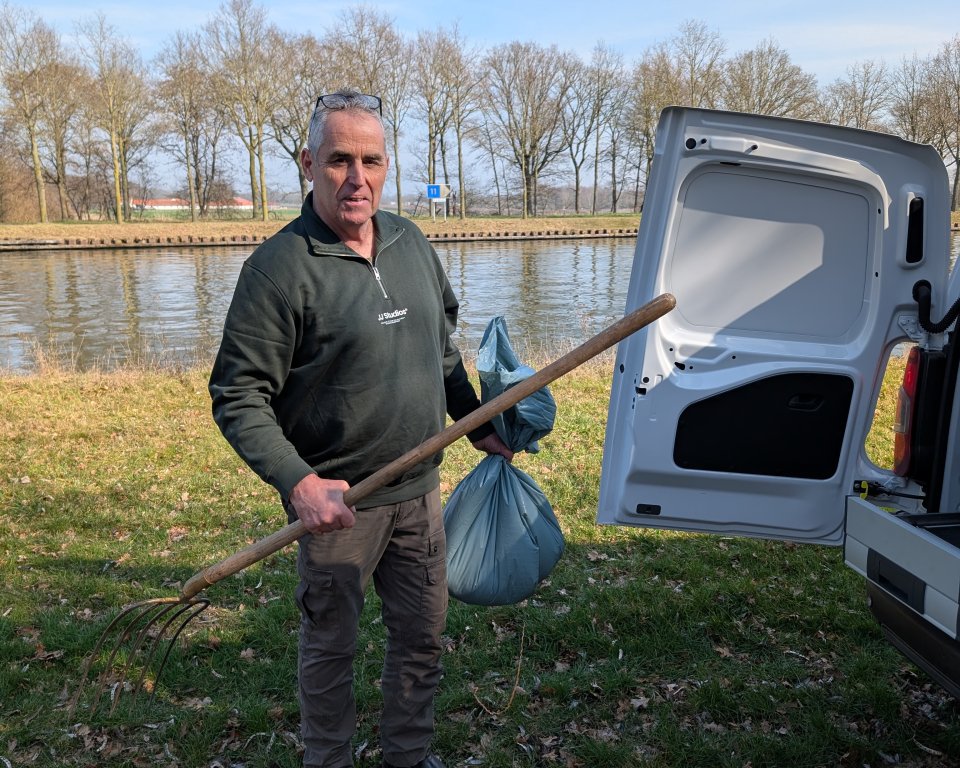
Meet Huub, Leudal’s municipal pest control specialist. Born and raised in Grathem, he has been fulfilling this unique and multifaceted role for many years. Huub is the face of pest control.
Red deer
With Huub, no two days are the same. He works with everything from the tiniest insects to large animals like red deer. But his work goes beyond just pest control; Huub interacts frequently with residents and assists with a wide range of issues often related to pest problems. Since his appointment, he has been taking courses and continuing education to stay up to date on developments in legislation, new methods, and changing conditions.
This is his story.
To relieve suffering
I never know exactly what I’ll encounter on a typical workday. I control and prevent nuisance caused by pests such as rats and remove wasp nests that pose a danger in public spaces.
In addition, I work on strategies to combat the Asian hornet, in collaboration with the province, the national government, research institutions, and cross-border partners, among others. We are constantly searching for effective and animal-friendly control methods, such as natural predators.I also have special authorizations. For example, I am authorized to euthanize seriously injured animals after a collision and to remove escaped livestock for safety reasons. I am one of the few people in Limburg with these authorizations, which is why I am available 24 hours a day to assist Rijkswaterstaat, the provincial government, the police, and the animal ambulance, among others.
Death brings life
“I also remove animal carcasses from public spaces, which is a legally mandated municipal duty. These carcasses are regularly used for research or for the ‘Aaseter’ project, whose slogan is: ‘Death gives life.’ As part of this project, carcasses are left in designated areas within nutrient-poor nature reserves so that microorganisms, foxes, vultures, wolves, and other animals can benefit from them.”
BuitenBeter app
Reports come in from colleagues, partner organizations, or residents, primarily through the BuitenBeter. When handling these reports, I prioritize preventing animal suffering (such as in cases of collisions), removing hazardous wasp nests, and helping residents deal with rat infestations—by taking action, reassuring people, and offering advice.
I work according to the IPM (Integrated Pest Management) method, which focuses on prevention. The goal is to eliminate the root cause of the problem. Because, as I always say: a rat that isn’t born doesn’t need to be controlled.
Consultation with government agencies
Our main collaboration takes place through the Municipal Wildlife Consultation Group (GFO), which I founded together with a former colleague and which now includes 18 municipalities. Through the GFO, we are in regular dialogue with ministries such as IenW, VRO, VWS, and LVVN. Together, we seek solutions to problems caused by invasive alien species such as the Asian hornet, tiger mosquito, Mediterranean ant, and raccoon.
Dutch Wildlife
I get a boost of energy from coming up with solutions that don’t yet exist. Sometimes I make my own new animal-friendly traps, for example for rats and the Asian hornet. I also support research conducted by Utrecht University, Naturalis, RIVM, and the Dutch Wildlife Health Centre (DWHC) by setting up experiments and providing carcasses for research. This includes research on avian influenza or new pesticides.
What particular situation has stuck with you?
The discovery of the first muntjac (a small deer) in Limburg. I handed the carcass over to DWHC for examination. I also found what may have been one of the first wolves in Limburg by the side of the road. An investigation revealed that this wolf came from a pack in Flanders.
What do you like most about your job?
Being outdoors and achieving results that were previously thought impossible. A good example is the introduction of rat culling as a pest control method. This began in Leudal and is now practiced throughout Limburg and even nationwide. The method may only be carried out by municipal employees who hold hunting licenses and have received special training.
Animal suffering
I can’t always be on the scene right away when animal suffering occurs. I’d prefer to act as quickly as possible, but unfortunately, that’s not always immediately possible. I find that difficult. Preventing animal suffering, helping people who are desperate because of nuisances, and receiving appreciation—that gives me a tremendous amount of energy.
Misunderstanding
Residents often see me as “the city” and ask all sorts of questions that have nothing to do with my job. And I understand that. People also think I only deal with animals, when in fact I regularly have to deal with completely different issues, such as criminal activity, illegal drug dumping, and marijuana farms.
What's your best tip?
Please do not feed the birds. Due to our mild winters, birds generally no longer need this. However, rats do take advantage of it, which leads to an increase in nuisance. By not feeding them, residents can prevent many problems and animal suffering.
Meet & Greet
Many people don’t realize just how diverse the work at the municipality is. My position is a perfect example of that. To connect with interested individuals, the Municipality of Leudal is hosting a Meet & Greet on Wednesday, June 10, at 3:00 p.m. It’s a casual opportunity for people to get to know the municipal organization and explore various career opportunities. Don’t miss it!