Slipperiness control
What is it?
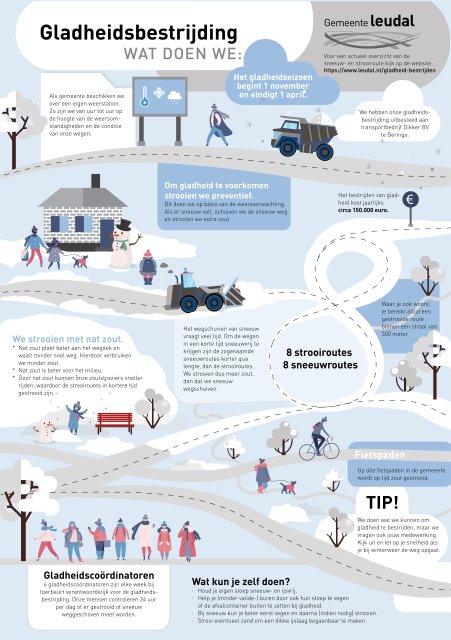
Winter has begun. For the municipality, this means that we are again on extra alert for winter conditions that can worsen road conditions. To keep accessibility as good as possible, a large number of roads are gritted. From you as a road user we also ask extra attention and alertness at times when you are on the road in wintry weather. On most roads the municipality controls the icing, but there are also roads within our municipal boundaries where the Province controls the icing.
The Municipality of Leudal has already started preparing for possible snowfall and slipperiness well before the start of the winter season. For example, the salt supply has been brought up to standard, all salt spreaders have been inspected, the ice coordinators have had an extra refresher course and all scenarios have been discussed with the contractor who gritters the roads for us. We are doing everything we can to make and keep it as safe as possible for users of the public roads and are ready for the coming winter.
How does it work?
Because we cannot grit everything, in our municipality we chose to grit the through roads and the free lying bicycle paths, among others. Below are the overviews of the gritting and snow routes for each core. The gritting routes are gritted regularly when ice is reported, the snow routes are only the main roads and bicycle paths that are gritted and possibly shoveled when snow falls.
The locations of gritting and snow removal are listed below.
Snow Routes
Use of a snow plow and salt is spread in the process.
- Haler | Neeritter | Ittervoort | Hunsel | Ell
- Kelpen-Oler | Grathem | Baexem | Heythuysen | Heibloem
- Roggel | Haelen | Nunhem | Neer
- Horn | Business park | Windmill forest | Buggenum
- Heythuysen | Roggel
Snow routes bike paths
Spreading routes
The roads and bicycle paths are gritted with salt.
- Ell | Hunsel | Ittervoort | Haler | Neeritter
- Heythuysen | Baexem | Kelpen-Oler | Grathem
- Roggel | Heythuysen
- Neer Roggel | Haelen | Buggenum
- Horn | Haelen | Business park | Windmill forest
Spreading routes bicycle paths
What to do
- Keep your own sidewalk free of snow and ice. You can even purchase road salt for this purpose if necessary.
- Help your (less able-bodied) neighbors by also sweeping their sidewalks or taking out the Waste container when it is slippery.
- With snow, it is better to sweep first and then grit (if necessary).
- When sweeping, keep gutters and manholes clear of snow.
- Sprinkle sand, if necessary, to make a thick layer of ice passable.
Caution! Stay alert for slipperiness, even if roads have just been gritted. Road salt starts working better the more traffic has driven on the gritted road. Road users always retain responsibility for adapting road behavior to (local) conditions.
What does the municipality do and what can you do yourself?