What's in store for us? Exploring Brightlands from Leudal
What will the agriculture of tomorrow look like? And what do a changing climate, new technology, and the emergence of new diseases and pests mean for entrepreneurs in Leudal? With these questions in mind, we set out on Thursday, October 1, with a group of entrepreneurs and stakeholders from Leudal to visit Brightlands Campus Greenport Venlo.
Of course, you can just wait and see what comes your way. But you can also go ahead and see what's happening.
That idea was a recurring theme throughout the afternoon. At Brightlands, participants weren’t presented with a distant future, but rather examples of developments that are already underway today.
Where does the future begin?
The afternoon began with Ingrid Vermeer, CEO of Brightlands Campus Greenport Venlo. She spoke about the campus’s role as a meeting place for entrepreneurs, researchers, and educators. At Brightlands, work is underway on major questions surrounding healthy food, future farming, and a bio-circular economy. But behind those big words lie very practical questions. How will we grow crops in the future when it’s hotter and drier more often? How will we deal with diseases and pests? How can we use less water and other resources? And how do we ensure that new knowledge actually reaches entrepreneurs on the ground? This immediately made it clear why it’s worthwhile to look beyond our own municipal boundaries.
Measure first, then decide
This was evident, for example, with AgroExact. Much of what they do revolves around something every farmer is familiar with: the weather. But while a weather forecast provides a general overview of what’s happening in a region, AgroExact wants to know exactly what’s happening on the field itself. Local weather stations and highly accurate precipitation measurements provide a much more detailed picture. That can make the difference between irrigating because the forecast suggests it might be necessary, or irrigating because you know what actually happened on your plot. After all, small differences in precipitation can have major consequences.
Research with Feet in the Clay
After that, the group literally headed out into the field. At Compas Agro, the participants saw how new cultivation methods and solutions are tested in practice. In the test fields, researchers investigate what works—and, just as importantly, what doesn’t. That makes the research tangible. It’s not just abstract theory, but crops that are growing, differences that become visible, and results that must ultimately find their way into practical application. For business owners, that’s perhaps the most interesting question: Will it work for me down the road?
The greenhouse in
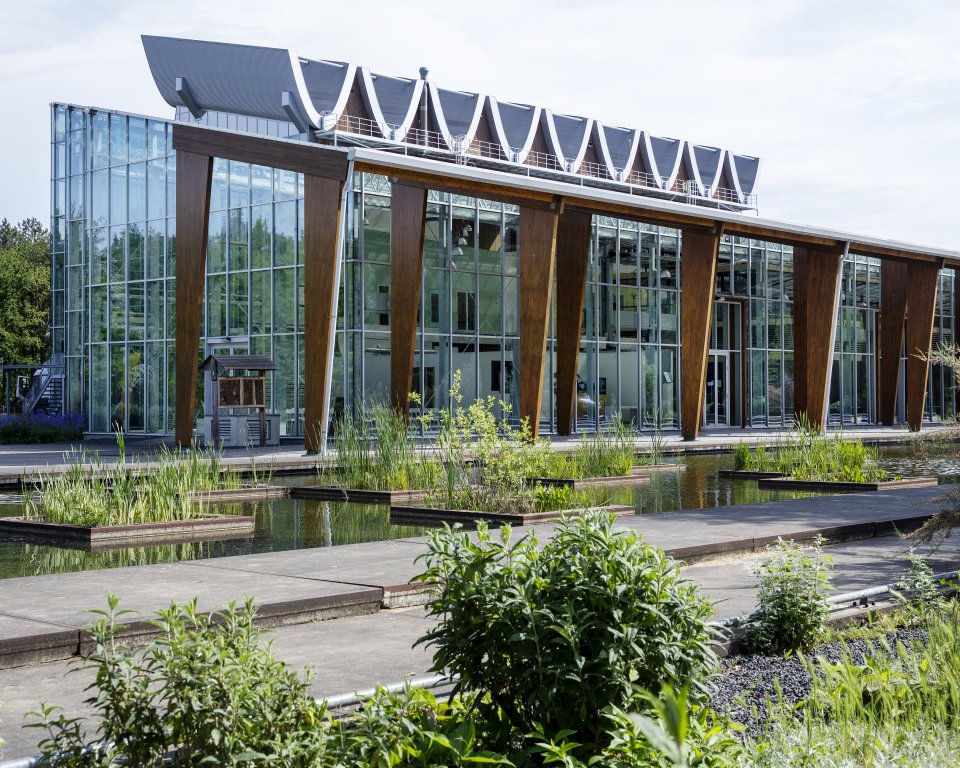
Next, the door opened to a whole new world of research: Maastricht University’s Nick Bos Greenhouse. Here, researchers are exploring the agriculture and horticulture of the future. Researchers and students can grow crops under various conditions and study the effects of factors such as heat and drought. You literally take a step into the future there. What happens to a crop as temperatures continue to rise? Can we make plants more resilient? Can we grow crops more efficiently while also improving their quality and nutritional value? These are questions that begin in a research greenhouse but may ultimately find their way into actual farming and horticultural operations.
From Major Developments to Leudal's Practical Approach
It was precisely this combination that made the visit interesting. Brightlands demonstrated where major developments converge. AgroExact showed how data and local weather information can aid in day-to-day decision-making. Compas Agro put research into practice. And Maastricht University demonstrated how scientific knowledge can help us take the next step. Four different perspectives, but one shared question: How do we ensure that our agriculture and food production are ready for what lies ahead?
For the participants, this was more than just a look behind the scenes. It also provided an opportunity to discuss their own professional practices with one another. What do we recognize? Where are the opportunities? Which developments are already relevant, and which still seem far off?
And what does this mean for Leudal?
In the end, that was the question we took home with us. Because innovation doesn’t always have to be big or complicated. Sometimes it starts with better information about precipitation. With a field trial. With a researcher exploring a different way of farming. Or simply with an entrepreneur who says, “I want to know more about that.”
The visit was made possible by Brightlands Campus Greenport Venlo, BASF-Nunhems, Ria Joosten Catering and Events, LLTB, and the Municipality of Leudal. Special thanks go to Rob Huijten, director of BASF-Nunhems, who guided the group with his enthusiasm and expertise.
We look back on an inspiring afternoon during which we not only saw what’s happening at Brightlands, but—more importantly—came away with many new questions. And perhaps that’s exactly the point: not to have all the answers today, but to be better prepared together for the questions of tomorrow.