
Questions and answers about Zevenellen Business Park

Below you will find frequently asked questions and answers (from the committee members) that directly or indirectly relate to developments concerning Zevenellen Business Park.
1. General questions
A. What is the municipal position regarding nuisance in terms of noise, odor, nitrogen, particulate matter, etc. ... on site, but also as a result of the many transport movements?
In order to establish businesses while protecting residents, the municipality has established frameworks and in the past adopted a zoning plan (now part of the temporary environmental plan).
By establishing these frameworks, the zoning plan and legal regulations, there is an objective assessment framework. Whether there will be nuisance is unknown. To the extent that there would be foreseeable nuisance, companies have obligations under the frameworks and laws and regulations to prevent or limit nuisance.
In the area of noise, for example, strict standards have been imposed. In addition, we assess noise cumulatively, thereby protecting our residents as much as possible.
B. Can an independent party look in to see if everything is also open and transparent?
All documents associated with a permit are public.
C. Which businesses cause nuisances to nearby residents and what is being done to reduce nuisances?
Businesses are not known to cause nuisances. Businesses must comply with legal regulations and will have to take measures to do so.
D. What is the province's vision for Zevenellen?
The county, like the municipality, must also review against the review framework.
E. What is the municipality about and what is the province about?
For this question, we would like to refer you to the Q&A that was previously shared with the committee members and which can also be found on the website of OML Sustainable Multifunctional Business Park Zevenellen:
...
3. Who is responsible for what?
The following parties are responsible:
- Municipality of Leudal when it comes to: licensing, supervision and enforcement (depending on company activities), zoning plans, Soil Quality Decree, zone management noises policy.
- Province of Limburg when it comes to: licensing, supervision and enforcement (depending on company activities) and soil remediation under the Soil Protection Act (Wbb).
- OML/WBCZ for their own site when it comes to: land sales, (new) settlers, green design and sustainability, area development (infrastructure, construction/demolition, etc.)
- Attero and Enexis are co-owners of the Zevenellen. However, they are not directly involved in the development of the business park. Attero is responsible for the section (northeast corner) where the fly ash depots are located. Enexis is responsible for the Enexis energy distribution station in the center of the site.
...
F. Has the municipality established what the basic position of the municipality of Leudal is regarding its role in the supervision, enforcement, and accessibility of the Zevenellen Business Park?
Municipality of Leudal has prepared a Position Paper for this purpose. This can be viewed via the button below.
2. Questions about health/air quality
A. What are the effects of Zevenellen activities Zevenellen the public health of the residents of Buggenum, Leeuwen, Swalmen, Roermond, and Beesel?
For the answer to this question, please see the presentation by Linda van Berkel of the Department of Public Works, Clean Air Agreement on Monday, April 15, 2024.
B. How is the background concentration of air quality around Buggenum-Haelen established?
To visualize air quality in the Netherlands, RIVM uses a combination of measurements and model calculations. This is necessary because neither provides a complete picture of air quality in the Netherlands. For example, measurements only provide insight into air quality during the measurement period and the results only apply to the measurement location. Measuring everywhere and continuously is practically unfeasible and expensive. Because many measurements are needed to get a picture of air quality over a larger area and for a longer period of time. Setting up and maintaining so many measuring stations and analyzing all the results for the whole year costs a lot of money.
A model does allow us to calculate current air quality for a large area. We can also use a model to get a picture of air quality for new situations. For example, the effects of measures yet to be taken to improve air quality or the prognosis for air quality in the future. A limitation of calculating with a model, however, is that a model is always a simplification of reality. The results depend heavily on the quality and completeness of the data entered. For example, the sources (for example, industry, road traffic or agriculture) that emit substances into the air are taken into account. As a result, the results have a greater uncertainty than the measurement results.
Measurement data are necessary to see if the calculations of the models are correct. We work continuously to check and improve the models. Models managed by RIVM are periodically calibrated against measurements. This is a quality control in which model calculations are compared with measurements.
Air quality measurements are carried out by various governments, engineering firms and private initiatives (such as AiREAS in Eindhoven). A distinction is made between measurements that comply with legal requirements and alternative measurements. Legally (in the Netherlands), model calculations by means of the CIMLK (centraal instrument monitoring luchtkwaliteit) are leading. Monitoring takes place on the basis of the Omgevingswet.
More information on determining air quality and the advantages and disadvantages of measuring and calculating can be found at the following link: Determining Air Quality | RIVM.
C. Can the municipality map the current background concentration of air quality in the Zevenellen area Zevenellen sensors that are installed there for several weeks?
No, it is not possible to measure the background concentration with a few sensors that are hung up for a few weeks. If we want to know the background concentration in the Zevenellen area, we have to rely on data from the RIVM. You can find the reasoning behind this in the overview of the advantages and disadvantages of measuring and calculating: Determining air quality | RIVM.
D. Did the background concentration of air quality in Weert and Nederweert arise from measurements only?
No, the background concentration for the Weert and Nederweert area also arises from measurement and calculation.
E. Where can I find current information about air quality in the Netherlands?
- Current air quality as measured at official monitoring stations: www.luchtmeetnet.nl/meetpunten
- Current air quality on land cover Map: www.atlasleefomgeving.nl and www.luchtmeetnet.nl/verwacht (same Map)
- Forecast air quality on land cover Map (by daypart, for next 2 days): www.luchtmeetnet.nl/verwacht ('My Air Quality')
- Annual average concentrations on land cover Maps: the Atlas Environment, available at www.atlasleefomgeving.nl
- Annual average concentrations at test points: the annual Monitoring Report, available at www.nsl-monitoring.nl/rapportages-en-documenten and on the interactive Map www.nsl-monitoring.nl/viewer/ (manual)
- Measurement results (annual averages and all other testable concentrations, trends): the reports of the air monitoring networks, available at www.luchtmeetnet.nl/rapportages
- Measurement results of all stations and hourly average values from several years: data.rivm.nl/data/airmeetnet
F. What is possible?
There are several initiatives nationwide to get a good picture of air quality in the Netherlands. Discussions are currently underway with RIVM about the SamenMeten program.
G. Presentation GGD Limburg-Noord.
On Monday, October 28, 2024, the municipality of Leudal organized an information meeting Zevenellen the theme of "Health in relation to air quality." GGD Limburg Noord was the guest speaker at this evening event. You can find the presentation here. Questions submitted in writing will also be added to this Q&A.
H. Is it correct that air quality is affected by truck exhaust emissions?
Yes.
I. Noise can also affect a person's health. Has noise been studied?
Noise is investigated by the companies themselves. The acoustic reports are then reviewed by external experts. Noise is also investigated with regard to the construction of the traffic circles (incl. future traffic movements in 10 years).
The province/environmental service of South Limburg recently commissioned the Limburg-Noord Municipal Health Service (GGD Limburg-Noord) to draw up health advice for both FUREC Zevenellen VTTI. This advice will include the aspect of noise, among other things.
J. Is there a willingness to monitor the health of local residents (over a longer period of time)?
Local residents concerned about living near industry (initiatives yet to be planned) sometimes request a health survey.
In practice, people mean different things by health screening. For example, it may mean that the GGD 'assesses the situation'. See question 2.I which states that the GGD Limburg-Noord prepares a health advice on behalf of the Province of Limburg.
The GGD LN also conducts a health monitor once every 4 years. The Health Monitor (Adults and Elderly) provides insight into the health of residents 18 years and older in the Netherlands. This questionnaire survey covers various topics, such as (mental) health, well-being, lifestyle, participation and living environment.
With the results, GGDs and municipalities can focus on improving the health of residents.
In addition, the advice is that it is important to maintain a dialogue with each other (e.g. agree that the company will inform local residents immediately if additional nuisance is to be expected).
K. According to the GGD, what are the health effects of air pollution on children and adults?
See presentation Rijkswaterstaat and GGD. This is also already listed under item 2.G.
What substances are we talking about? Include emissions from industrial sites and from (heavy freight) traffic. How many children/adults are involved?
See also for this the presentation Rijkswaterstaat and GGD via the button above.
L. Air quality monitoring stations are to be installed in South Limburg. Given the developments in Zevenellen, is the Municipal Health Service (GGD) in favor of installing monitoring stations in the Central Limburg region now, so that comparisons can be made later?
It is true that measuring stations will be installed in South Limburg. These are measuring stations for measuring ultrafine particulate matter. Careful consideration was given to determining the locations of these new measuring stations.
It is not necessary Zevenellen install measuring stations in the vicinity of Zevenellen . The Municipal Health Service (GGD) also plays no role in the choice of locations. These are determined by the National Institute for Public Health and the Environment (RIVM) and the province of Limburg. The nearest measuring station is located in Nederweert.
What role can the Municipal Health Service (GGD) play in Zevenellen the installation of a measuring station at Zevenellen ?
The GGD does see added value in a measurement network with sensors in the context of the Clean Air Agreement for the municipality of Leudal, but clearly indicates that there are important Requirements in deploying a measurement network with sensors, including expectation management and establishing a good research question.
For more information about these monitoring stations in southern Limburg: The air you breathe in Limburg is dirtier than you think | ONLINE (youtube.com)
M. Does the Municipal Health Service (GGD) have a clear picture of what Zevenellen happen in Zevenellen , which factories will be built there, and what health effects this will have on residents of Central Limburg? What evidence is there of this? Could you explain this to us?
Yes, the Municipal Health Service (GGD) is aware of what Zevenellen happen at Zevenellen . The GGD has been asked by both the municipality and the environmental service/Province of Limburg to advise on individual initiatives at Zevenellen.
The municipality of Leudal has signed the Clean Air Agreement and is going to start working on an air program. The GGD LN will also participate in this program. One of the goals is to work towards the WHO recommended values by 2030.
Permit applications are reviewed against the review framework/standards. For air quality, a study is conducted. Emissions are compared to the background concentration.
The GGD looks at the background concentration, the blanket as explained at the information meeting on October 28, 2024. In the presentations of the GGD and Rijkswaterstaat you can find what determines the background concentration.
N. What measures will the Municipal Health Service (GGD) take to protect local residents and the inhabitants of Central Limburg from the nuisance caused by Zevenellen?
The answers to this question have already been given in questions 2.J (health monitor) and 2.M (participation program air to implement the SLA).
In addition, the environmental department continues to monitor emissions from companies.
O. Knowing that the future advisory values are already exceeded now and the advisory values are outdated until 2030, how do you prevent the values already measured today from increasing further?
When granting environmental permits, the air quality is tested against the European limit values which are anchored in the Bkl and before 01-01-2024 in the Environmental Management Act.
The province also explained during the meeting on June 4, 2024 that they grant permits at the lower end of the range.
The Clean Air Agreement (SLA) assumes that the signatories will work towards the WHO advisory values in 2030. Research has shown that 2030 seems too soon and therefore additional measures are needed which are included in the 2024-2030 implementation agenda.
See https://www.schoneluchtakkoord.nl/sla-0/overzicht-luchtkwaliteitswaarden/
The Dashboard SLA shows how the implementation of the 2024-2030 Implementation Agenda and the decentralized implementation plans are progressing.
Meanwhile, on Oct. 14, 2024, the European Council formally adopted the new European Air Quality Directive. Starting in 2030, stricter requirements will apply to, for example, particulate matter and nitrogen dioxide. Within 2 years, the Netherlands must transpose the European rules into national legislation. See https://www.schoneluchtakkoord.nl/actue el/nieuws-schone-lucht-akkoord/algemeen/europese-raad-geeft-groen-licht-aanscherping/
P. What measures (possibly with cooperation partners) are in place to achieve the goals of the Clean Air Agreement within the municipality of Leudal?
These measures are described in the annual implementation plan. One of the components is "citizen science" (self-measurement by residents).
Q. The Q&A explicitly states that the cumulative effects of noise and odor will be tested. Is it true that the cumulative effects of other nuisances such as air quality are not tested?
If so, why is air quality not tested while noise and odor are?
If not: why not?
For air quality, individual companies are tested against the limit values in the Bkl and before 01-01-2024 the Environmental Management Act. For this assessment, a designated dispersant is used, in which, based on the released emission to air, the concentration at ground level (immission) is calculated. Then this calculated immission of the individual company is added to the background level at the site (so-called GCN Maps) and tested to see if the limit value can be met. These GCN Maps are provided annually by RIVM. This can be seen as a form of cumulation.
In addition, at the Oct. 28, 2024 meeting, Alderman Den Teuling agreed to provide insight into cumulative air quality impacts.
R. How is it possible that the municipality of Leudal does not know whether there will be nuisance from cumulative effects of air pollution? So how does the review framework specifically protect residents from harmful air due to excessive concentration values?
See the answer to question 2.Q
What are the cumulative standards/ limit values within the review framework for various airborne substances (NOx, SOx, NH3 and particulate matter, for example)? And how do these relate to WHO standards (EC obligation 2030 and 2050)?
See the answer to question 2.Q
S. Based on the assessment framework, what are the expected air quality values in the immediate vicinity of Zevenellen, in the surrounding villages of Leudal, and in Roermond if the Zevenellen zoning plan is fully implemented?
(including Asselt, Swalmen, Leeuwen, De Weerd, Mijnheerkens)
See the answer to question 2.Q
T. And what are the expected values assuming the plants already planned (licensed), also incl. transport movements?
See the answer to question 2.Q
U. Is the municipality participating in the EU consultation on reducing sulfur dioxide, nitrogen oxides, volatile organic compounds, ammonia and particulate matter? After all, these substances are harmful to humans and the environment.
Local governments also share responsibility for monitoring and reporting on the state of air quality. Please explain with examples showing this.
The Emission Inventory annually records emissions from all relevant Dutch sources. The Emissions Registration calculates most emissions itself and checks companies' emissions supplied annually via the annual environmental report. The Emission Inventory is a partnership between five research institutes. RIVM has final responsibility for the Emission Registration. These figures are forwarded to the EU.
The Central Instrument for Monitoring Air Quality (CIMLK) aims to make air quality data on the Netherlands available to everyone in one place, uniformly and easily accessible, thereby (digitally) supporting air quality legislation and regulations. Every other year, SLA participants provide data (livestock farms and road traffic) for air quality monitoring.
The following link provides more information and an introductory video Emission Registration: All emission data in one place | Emission Registration.
On the website of the Environment Information Point you can find more information about air emission requirements and monitoring in environmentally harmful activities.
V. What emissions from freight traffic are expected specifically for residents living on Roermondseweg in Haelen (the access road to Zevenellen)? And what health risks do they face as a result?
For the answer to this question, please refer to the GGD presentation. This is a general answer because the health risks are also related to the background concentration. This local "hot spot" as named on October 28, 2024 concerns only a very small percentage of the background concentration.
Does this include the effects of the two traffic circles where truck traffic in particular has to constantly brake and accelerate causing additional emissions?
For the answer to this question, please refer to the GGD presentation. This is a general answer because the health risks are also related to the background concentration. This local "hot spot" as named on October 28, 2024 concerns only a very small percentage of the background concentration.
W. How far do emissions from heavy goods vehicles and other traffic flows extend? The traffic model used indicates that a maximum increase of 1,000 trucks and 4,000 passenger cars per day is possible from Zevenellen .
Emissions from truck traffic and other traffic flows may affect air quality
For this we refer to the presentation of April 15, 2024 (see section 2.A) and October 28, 2024 (see section 2.G) where traffic emissions were discussed.
X. The Municipality of Leudal is bound by the precautionary principle from the omgevingswet and the European Convention on Human Rights and therefore responsible for a safe and healthy living environment.
Precautionary principle
The precautionary principle is the principle whereby companies and governments take action when there are reasonable grounds to believe that activities may have adverse effects on the environment or health. These are activities where the available scientific data give indications of a risk, but insufficient scientific evidence is yet available on the nature or extent of a risk.
How does the municipality assume this responsibility when there is no actual insight into the consequences of the air pollution that the combined factories and traffic in Zevenellen cause? What evidence is there, or will there be, that the municipality is applying the precautionary principle?
It is not always clear in advance whether human actions will lead to risks to people and the environment. Such uncertain risks can arise, for example, in safety issues, but often also in activities with potential health consequences. A well-known example is the introduction of new substances.
Precautionary measures may also play a role in the granting of permits (Zevenellen). These mainly involve proportional measures to avoid effects or emissions as much as possible.
The competent authority may impose customized regulations from a precautionary perspective.
How to apply precaution?
The European Union and the national government already take precaution into account when drawing up and developing (the level of) standards. For example, a margin of uncertainty is built into standards and it is also taken into account in environmental values and instruction rules, whereby other interests are also taken into account. The precautionary principle is not about risks of exposure above the norm, but about 'non-normed' risks. In addition, the precautionary principle can also be applied in some cases when there is a standard but it is not certain whether it is adequately protective.
Applied to Zevenellen
In 2017, this was assessed by means of a general risk analysis. This analysis looked at the maximum capacity of Zevenellen in accordance with the current environmental plan), i.e., a worst-case scenario.
Alderman On October 28, 2024,Alderman Teuling promised that he would have this assessment updated.
The authority takes its responsibility for a safe and healthy environment seriously, even when there are uncertainties about the effects of air pollution. Here are some ways the municipality applies the precautionary principle:
Licensing and Supervision
When granting environmental permits, strict Requirements are imposed on companies to limit emissions of harmful substances. The competent authority conducts regular inspections to verify that companies are complying with these Requirements .
Monitoring and Reporting
The competent authority requires companies to monitor and report their emissions. This helps in understanding air quality and taking targeted measures when necessary.
Y. The municipality of Leudal and other municipalities in Limburg are interested parties in the RWE project.
If they Zevenellen to deliver their household waste to the RWE plant in Zevenellen , they also have a Health to ensure that the waste does not Zevenellen to the Zevenellen area via the air. The planned plant in Zevenellen almost certainly have higher CO2 emissions than the waste processing facilities where the waste is currently sent. According to the Environmental Impact Assessment Commission, RWE will produce 840,000 tons of CO2 emissions. CO2 studies by CE Delft and others also show that, in terms of total CO2 footprint, other methods of waste processing that focus on recycling, energy production, and CO2 capture are currently more effective than the technology that RWE intends to use.
Knowing this, is it acceptable to the municipality or municipalities? If so, how do you justify this? If not, what actions will you take to prevent this factory from Zevenellen in Zevenellen ?
RWE's application is being handled by the province. The municipality is a consultant. The application is reviewed against legal frameworks and standards.
3. Questions about traffic
A. What about the safety of cyclists, especially towards Roermond and back, around the entrance/exit to the N280 and State Road in Horn?
Cyclist safety was included in the broad traffic study. This was also explained to the physical committee in 2023. The bottleneck analysis also looked at cyclists. In March 2024 an additional assignment was given to Kragten consultancy to take another look at the Berikstraat - Roermondseweg intersection. The study indicated that there is no bottleneck here, but in consultation with the Buggenum Village Council it was decided to look at improvements anyway.
In response to the physical committee dated October 2023, following questions from the committee members, an additional capacity calculation was performed by RHDHV for both the crossing and settlement from the parallel road and for the connection of the access and exit ramps. The analysis showed that the average waiting time for cyclists is classified as 'good'. This applies both to the crossing of the State Road from/to the parallel road and to the crossing cyclists at the entrance and exit to the N280. The average waiting time for crossing cyclists is therefore acceptable and this reduces the risk of accidents, for example because people will take greater risks if they have to wait a long time. By the way, there will always be cyclists who have to wait longer, in case of heavy traffic. Both crossing locations have good visibility of approaching traffic.
It is impossible to guarantee that traffic safety issues will not arise; that is never possible. From a capacity perspective, there is no reason to reconsider the level of traffic safety. What is currently happening in practice, particularly on the exit ramp, is that some motorists are giving way to cyclists crossing the road. Because there are two lanes on the exit ramp, this sometimes leads to unsafe situations. This is unrelated to the development of Zevenellen. Zevenellen total traffic contribution Zevenellen this location is limited.
B. In the short term, can the port play a significant role in reducing the nuisance caused by numerous transport movements? What is the worst-case scenario under minimal use of the port?
The port crane and existing quay will be demolished in the very near future on behalf of OML. A new quay will then be constructed.
Each company indicates in the permit application to what extent they intend to use the port. It is also clear what it means for truck transportation if the port cannot be used.
In accordance with previous explanations by Consulting firm Kragten on June 20, 2023 and October 24, 2023, the broad traffic study is in fact a worst-case scenario. The numbers therefore take into account the possibility that the port cannot be used.
C. What will things look like when there is high water and some approach routes cannot be used?
Studies and permit applications do not take into account periods of high water. These are incidental cases.
D. Is it correct that there will soon be less traffic on Napoleon Road than in the situation before the construction of the A73?
Below you will find the complete traffic study as explained to you on October 24, 2023. Table 2 on page 10 provides an overview of traffic movements on Napoleonsweg with and without Zevenellen.
Comparing those numbers to the numbers the county has available from the past, traffic at count location No. 3 (see Figure 4 of the traffic study for an overview of the count locations) (traffic volumes in 2040: 13,100) remains well below the old traffic volumes (traffic volumes in 2007: 18,203).
At counting location no. 6 between the N279 (towards Heythuysen) and the N280, we see an increase compared to the past, but this is also the case without Zevenellen. This is also reflected in Table 2 of the traffic survey.
E. Are motor vehicles monitored/is the municipality willing to do so? This can be used for enforcement.
Yes, the municipality has previously indicated that it will monitor this using traffic counts. Specifically, this means that counts will be carried out annually or every 2 years.
As of 1-1-2026, it is also mandatory for municipalities to monitor data on traffic intensities, maximum speeds and types of road surface in the national Central Facilities Noise Data (CVGG). Every 5 years (or more frequently) these data must be updated. The CVGG thus helps to exchange data for acoustic research and to monitor noise production.
F. In the event that the preferred route is not available, is there a willingness to reduce the number of transport movements to a mutually agreed (responsible) maximum?
The question can be put to companies, but this cannot be enforced. The province and municipality do not require this of companies. Apart from Zevenellen , the Roermondseweg Zevenellen used in the event of emergencies. This remains Sun. Roermondseweg is an access road.
4. Questions about permits
A. What environmental categories are there at Zevenellen where? And what types of companies could these be?
As decided by the municipal council on June 25, 2013, environmental Zevenellen up to and including 5.2 are permitted at the Zevenellen Business Park.
You can view the list of business activities here .
For more information, please visit the website Rules on the Map Omgevingsloket (overheid.nl). You can enter an address, for example Roermondseweg 57a, Haelen. By clicking on a location within the Zevenellen area, you will be taken to the screen below. Then click on 'Haelen industrial estate' at the bottom left.
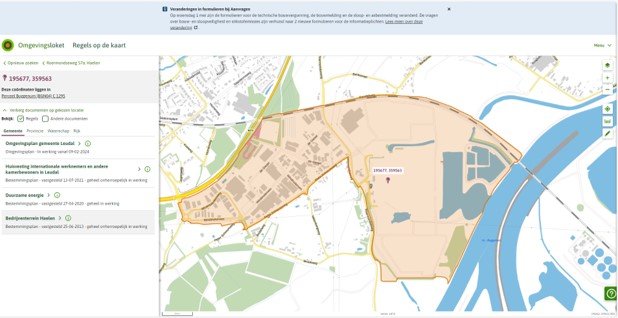
You cannot find what you are looking for through this link? Feel free to contact BBPOmgeving or Ms. L. Ponsen at the general number of the municipality (0475) 85 90 00.
B. How is the cumulative odor policy made clear to businesses?
The developers refer to the applicable rules in Zevenellen in the purchase agreements. When a company submits a request for information to the municipality or province, reference is also made directly to this odor policy.
C. Which companies want to establish themselves on the Zevenellen site? What measures are these companies taking in terms of the environment and emissions?
We would like to refer you to the latest presentation to the committee on October 24, 2023. During each presentation, an overview of potential tenants was shown. That overview is still current, with the exception of Ecoservice Europe. Ecoservice Europe, the company that now also has a permit, has definitively decided not to establish itself at Zevenellen.
D. What (legal) options does the municipality have to address the concerns of local residents and stakeholders?
We understand the concerns of local residents, but there is an objective review framework. An explanation of that review framework will be provided on June 4, 2024. The grounds for refusal will also be expressly addressed here.
We ask residents to expressly state what they are concerned about. We can then see if and what we can do to try to address the concerns.
5. Questions about companies
A. Is the arrival of Furec (RWE) already fixed or can it still be stopped?
The establishment of Furec (RWE) is subject to the granting of permits by the competent authority. For RWE, this is the province. Several permits are required. These permits are not yet irrevocable, not yet granted or not yet applied for.
B. Why doesn't Furec locate near Chemelot or the highway?
The Zevenellen location Zevenellen chosen for the proposed initiative for the following reasons:
- The zoning is suitable for the said activity in terms of space and environmental category;
- Its direct location on the port allows the number of transport movements and associated emissions and nuisances to be minimized;
- FUREC will be fully electrified and requires an industrial power connection. Such a facility Zevenellen available at the Zevenellen industrial park.
- The FUREC objective fits in seamlessly with the Zevenellen site's ambitions Zevenellen terms of sustainability and circularity.
The Chemelot site is destined for chemical activities that strive for optimal integration and synergy between the various activities. The scarce land available at Chemelot is classified as environmental category 5 and must be used as such to strengthen the chemical cluster. Available locations for chemical initiatives in Limburg/the Netherlands/Europe are scarce, which is why the vacant lots at Chemelot are reserved for such activities.
In addition, the Chemelot site is not located directly at the port. Pelletizing waste at Chemelot would mean that household waste/garbage would also have to be transported by road. This would make the pelletizing unit "land locked."
Pelletizing in the port of Stein was not an option because there was no 10 ha available for the "pelletizing installation" and the necessary E-connection was also not available. This also applied to the other (port) locations investigated in the Euregio around Chemelot.
C. response to state questions by GS Province of Limburg
6. Questions about monitoring and enforcement
A. How does nuisance become transparent and measurable to the environment? How does enforcement work?
It is not clear whether nuisances will be created. And for each aspect such as air, noise, traffic, etc. ... this is controlled differently. Control measurements may be required at the start, periodic measurements or traffic counts.
The moment enforcement is at issue as a result of complaints or a general inspection, action is taken by the competent authority. Enforcement is handled in accordance with our VTH policy and the National Enforcement Strategy (LHS).
In 2019, the physical committee was also informed about the letter from the province regarding questions about enforcement. The request of the city council at that time was to make private agreements with the companies. Below is again an excerpt from this letter.
…
In the environmental permit granted for Coöperatie 7LL and the environmental permit yet to be granted for other initiatives, all relevant environmental aspects have been and will be weighed up on the basis of current legislation and regulations, and will include how the highest possible level of protection of the environment, and therefore also the surroundings, will be achieved. In order to achieve this, it is assumed and prescribed that Best Available Techniques (BAT) will be applied within an establishment. This includes (where relevant) assessment against the odor policy of the municipality of Leudal, the 50 dB(A) noise zone around the Zevenellen industrial estate, air quality limits, and the legal frameworks for (external) safety and public health.
Furthermore, regulations are attached to an environmental permit that are necessary to prevent or, if this is not possible, to limit and undo as much as possible the adverse effects that a facility may cause to the environment. This means that if the permit includes target requirements (standards), as well as a measurement obligation to demonstrate compliance with the standards. For example, the phase 1 environmental permit granted by GS on November 7, 2019 to Cooperative 7LL (manure processor) includes standards for odor and noise with a corresponding measurement obligation. We assume and firmly monitor that the standards are met in practice and therefore there cannot and should not be any unacceptable nuisance.
With regard to the supervision and enforcement of all environmental permits granted by the GS, we follow the provincial enforcement policy, and the National Enforcement Strategy (LHS) that forms part of it. In concrete terms, this means that from the start of the construction work of a licensed company, supervision will be carried out and, if necessary, enforcement action will be taken using the legal (administrative) means at our disposal. Even when a company is operational, regular (un)announced supervision of compliance with the permit (regulations) will be carried out and, if necessary, enforcement action will be taken. Naturally, checks will also be carried out in response to any complaints or enforcement requests received from the surrounding area.
By strictly following the LHS, we opt for one uniform approach to supervision and enforcement of all licensed companies for which GS is the competent authority; separate agreements per company on how to act if a violation is found during supervision are therefore not an issue.
...
B. Is the municipality willing to carry out measurements on emissions and noise around the business park? If so, do you agree with us that monitoring and measuring also implies (clear) accountability and enforcement (agree enforcement protocol)?
We are exploring the possibilities of joining North Limburg's Boundless Measuring. This is ongoing internally as part of the Clean Air Agreement.
For now, there is no administrative position on joining Boundless Measurement.
But as we previously communicated to the physical committee and explained at plenary meetings, these possible measurements will not be used to enforce. It is not that we are against measuring, but the college is concerned about the expectations and the purpose to start measuring. Hence, the college has also previously communicated to the city council what the (im)possibilities are and what the costs are (committee meeting Jan. 31, 2023 and motion 2021-60).
7. Questions about communication
A. Is communication with all involved satisfactory?
As a municipality, we want to communicate openly and transparently about potential settlers, topics and work. The way we do this may vary from topic to topic. And in addition, we are happy to adapt when there is a need for a different approach.
Currently, we choose to hold public information meetings at least twice a year. The topics for these meetings are provided by stakeholders. At least twice a year, we want to have a physical discussion in the committee meeting about the topics that are provided. Companies are also advised to conduct an environmental dialogue when applying for an environmental permit. If there is a deviation from the zoning plan (now part of the temporary environmental plan), companies are required to conduct an environmental dialogue. Involved parties will also have the opportunity to individually discuss their questions or comments in a monthly walk-in clinic.
B. How do local residents know that their concerns are being taken seriously?
Concerns of residents are taken seriously. This is one of the reasons why we make extra efforts to carefully review permit applications and engage an external independent agency for this purpose. This applies to both municipal and provincial facilities. Point 9 indicates how we inform local residents.
C. What will be done with third-party suggestions?
See question 1. Various additional assignments have been set in the area of traffic.
Residents have also made suggestions in the areas of greenery and rainwater storage. These suggestions have been incorporated into the plans. For more information, please refer to the OML newsletters about Zevenellen the link below.
D. How will residents' concerns, questions and suggestions on Peter Schreurs Road be reviewed and fed back?
The concerns and questions of the residents on Peter Schreursweg have been included in the traffic decisions of the traffic circles and in the responses to the views against these traffic decisions. In fact, part of one of the draft traffic decisions includes the truck ban on Peter Schreursweg.
It was also looked at internally to pull the parts related to the Peter Schreursweg forward, but from the perspective of integrality it was ultimately decided to take them together.
E. Is it an idea to hold periodic drop-in hours where people can tell their stories and hear about current developments?
In response to this request, it was decided to organize a walk-in clinic. It is a pilot for 6 months. After these 6 months we will evaluate if we see an added value and if there is enough enthusiasm for it.
The walk-in consultations will take place monthly on the first Tuesday of the month from 16.30 to 17.30 in the town hall. This will be announced via our website and newsletter.
F. Do residents gain an understanding of the process and is known when and in what capacity they can and may respond.
In 2022-2023, an infographic was prepared by OML 'Together from idea to realization'. This infographic is also on the OML website and is still applicable. However, an inventory will be made during 2024 whether we need to add new terms from the Omgevingswet .
Building plans must be reviewed against the building provisions of the zoning plan (now included in the temporary environmental plan).
The zone management plan (noise standards) ensures that many business activities must take place indoors.
Zevenellen completely enclosed by a wall with adjacent commercial buildings. This is because there is a road between the railway and the commercial plots. Companies can install an acoustic wall on the plots themselves, but they will have to comply with the building regulations in the environmental plan.
The question of what effect such a wall would have and how high it would need to be cannot be answered without further research.
The municipality does not see any possibility of ProRail contributing to the cost of this wall. It is not ProRail's responsibility to build a wall around the industrial estate.
More information
The OML website also contains a list of frequently asked questions and answers about Zevenellen Business Park.
View frequently asked questions and answers on the OML website
Information boards highlight the nature and history of Zevenellen
The Zevenellen business park Zevenellen Leudal is undergoing rapid development. At the heart of this (future) bustling area lies a green gem: 'De groene Long' (The Green Lung). OML recently installed two information boards here that tell visitors more about the rich history and unique nature of this area.
Green oasis
The 'green lung' is a beautiful, green oasis in the middle of a (future) industrial and bustling area. It is a nice place for a short walk, for example during the lunch break or for new inspiration. For employees on the site as well as local residents and visitors it is an interesting and beautiful place for a nice walk.
There are informational signs at two spots in the Green Lung. These signs take you through history and nature of this area with interesting and fun facts
- The sign on the south side of the green lung tells about the history of the site. The large Maas Power Plant and the Willem-Alexander Power Plant (both power plants) played a very important role in the growth of the surrounding villages.
- The sign on the north side of the green lung zooms in on the flora and fauna in the area. Did you know that very enthusiastic beavers dwell in the area? And that partridges like to rest here on their flight south? You can read more about it on the signs.
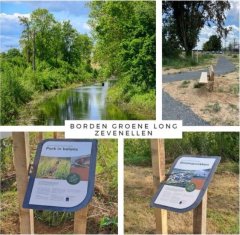
Are you coming for a walk around the block?
We warmly invite you to come and discover what this area has to offer for yourself. You will be surprised at how nature, the past, and the present go hand in hand in this little corner Zevenellen. A walk around the 'green lung' takes about 25 minutes.