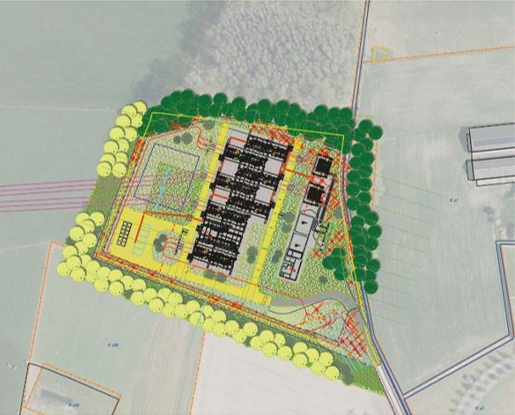
Renovated Kelpen-Oler High-Voltage Substation Ready to Meet Growing Demand for Electricity
On August 19, Alderman , Michel Graef, and several employees from the municipality of Leudal visited the renovated high-voltage substation in Kelpen-Oler. TenneT employees briefed the visitors on developments in the power grid and gave them a tour of the site.
Safety First
The visit began with a brief presentation about the substation and TenneT’s operations. This was followed by a tour of the site. It immediately became clear that safety plays a key role. Everyone entering the site must first complete a mandatory safety briefing. Without this briefing, access to the substation is not permitted.
Strict safety rules were also in effect during the tour. As a result, all visitors wore a hard hat, a safety vest, and safety boots.
More capacity on the power grid
The high-voltage substation is in dire need of modernization. Demand for electricity is rising sharply, while parts of the power grid in Limburg are outdated and operating at maximum capacity. For this reason, many substations and transmission lines will be modernized and expanded in the coming years.
TenneT and Enexis are working closely together on this project. At the substation in Kelpen-Oler, TenneT’s high-voltage grid connects to Enexis’s medium-voltage grid. The upgraded 150-kilovolt substation provides additional transmission capacity for the power grid in Central Limburg. The new substation began operations in January 2026.
Expansion Continues
Although the renovated station is now in use, construction is not yet complete. Part of the old station still needs to be demolished. Four additional “platforms” will then be built on this site, which will increase the station’s capacity even further. This expansion is scheduled to open in 2027.
Faster Construction Through Standardization
The challenge for the coming years is significant. TenneT and Enexis need to build many new high-voltage substations or expand existing ones. To do this more quickly and efficiently, they are increasingly using modular and standardized substations.
Components for these substations are manufactured and tested in advance at factories. They are then transported to the substation site and assembled there. This approach makes it possible to build faster. At the same time, fewer technical personnel are needed on site. This is important because technical personnel are in short supply.
The visit to Kelpen-Oler gave the municipality a good idea of what is required behind the scenes to prepare the power grid for the future. This development is not only technical in nature but is also of great importance to residents, businesses, and the ongoing transition to sustainability in Leudal and Central Limburg.