
Reconstruction Tramstraat, Maassenstraat and Groenstraat in Roggel
We will reconstruct Tramstraat, Maassenstraat and Groenstraat. On Tramstraat we will not carry out any work on the provincial road, only on the parallel roads along which the homes and businesses are located.
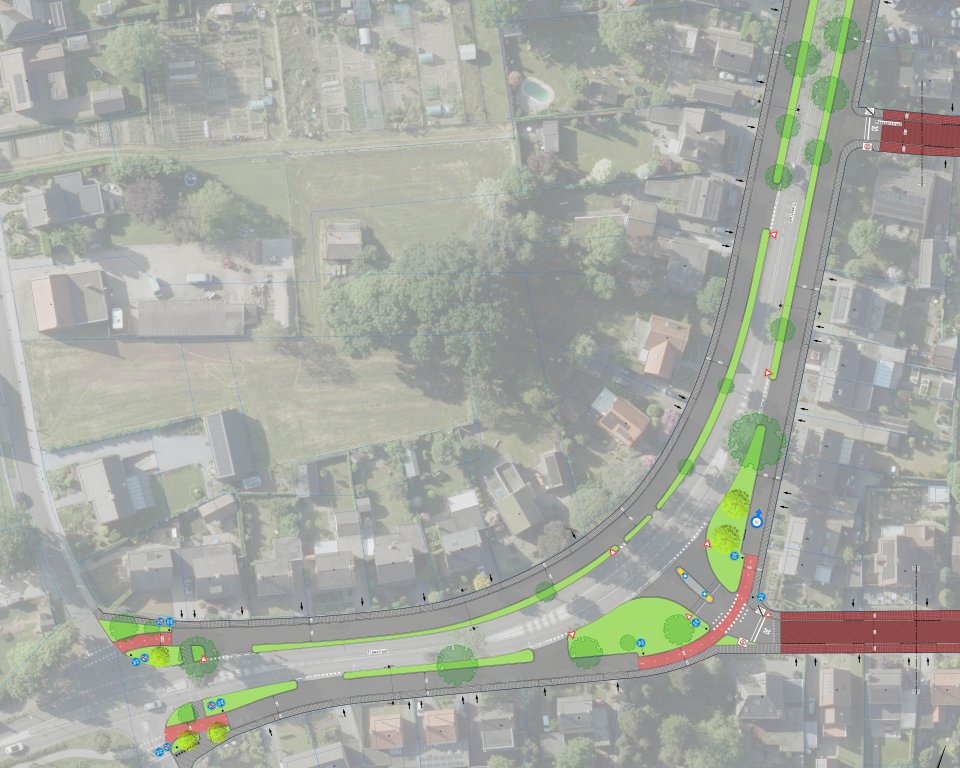
What are we going to do and why?
Road and sewer inspections have revealed that the roadway and sidewalks are in need of replacement and the main sewer is still in good condition. In addition, we are going to disconnect the public space from the existing sewer by constructing a rainwater sewer and allowing the rainwater to infiltrate on site. This will bring us as a municipality another step closer to meeting laws and regulations for handling sewage.
Information evenings
On Tuesday, October 8 and 15, together with the consulting firm Ducot, we organized information evenings for local residents and businesses of the streets we will be working on. The plans were not only presented on these evenings, but there was also constructive group discussion about the designs. After all, the residents are the people who walk, bike or drive their cars there every day and know what is happening and needed in their street. Many of the comments and suggestions made will be incorporated into the sketch design. The residents have been informed about this by letter.
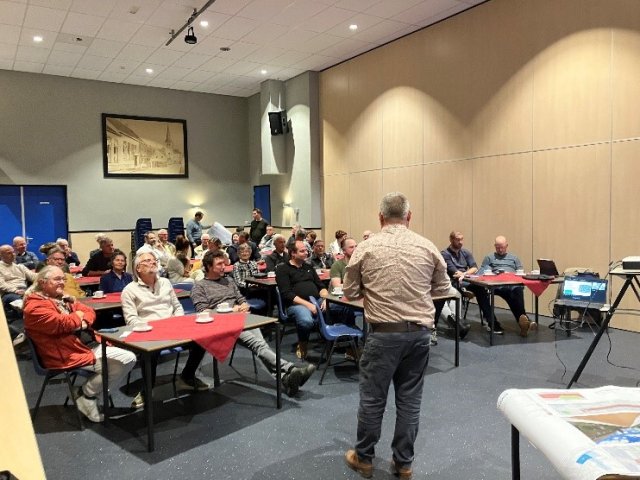
We look back on two well-attended residents' evenings where we gathered a lot of information and looked together at how best to design the roads.
Pavements
Streetcar Street
The parallel roads of Tram Street are through bicycle routes. To increase bicycle comfort, we will replace the clinkers in the road with asphalt.
Maassenstraat and Groenstraat
Maassenstraat and Groenstraat are two residential streets. To emphasize this more, we are going to replace the asphalt with clinkers. This will give the road users more of an idea that they are in a residential area and this will have a positive influence on the driving behavior and speed of road users.
Sewerage
Existing sewer
The existing sewer is of such quality that it can be maintained. In this project, we will replace the house connections to the sewer from the main sewer in the road to the boundary of the plots. We also install an unblocking point on the boundary of your lot. This will allow any sewer problems to be investigated and fixed more quickly.
Disconnecting public space
A stormwater sewer/infiltration facility will be constructed adjacent to the existing sewer system. With this facility, the public space will be disconnected from the existing, mixed, sewer system. We do this not only to prevent flooding, but also to prevent clean rainwater from being transported to the sewage treatment plant. After all, it is a waste to purify relatively clean water one more time. Moreover, in this way we put less of a burden on the sewage treatment plants when it rains and can thus keep treatment costs as low as possible.
We are still investigating where and how to infiltrate (sink this stormwater into the soil).
Advantages
- Rainwater soaks into the ground where the rain fell. This allows the trees and plants to use it;
- Groundwater levels are better maintained this way;
- We prevent the overflow of, not treated, sewage into nature;
- The sewage treatment plant is not affected by large amounts of rainwater after rainstorms. As a result, the treatment process is less disrupted and costs can be kept as low as possible.
What can you do yourself?
You too can disconnect (part of) your home from the sewer system. There are several ways to do this. To help you with this you can look at the page Subsidy for disconnecting rainwater(www.leudal.nl/subsidie-afkoppelen-hemelwater). It explains how the subsidy works. Would you like to see examples of how to disconnect? Then check out the page from Waterklaar(www.waterklaar.nl).
So how do we move forward?
Preparation
The project is now being further prepared by the municipality together with consulting firm Ducot. All the necessary studies are being carried out, the drawings are being further elaborated, the specifications (work description) are being drawn up. This will be followed by the tendering process and the work will be awarded to a contractor. Then the contractor starts preparing the work to finally start carrying out the work in different phases. The phases are determined at a later stage. By working in phases, the inconvenience to local residents will be limited.
The current schedule of work is as follows:
- Work Preparation
- 4th quarter 2024/2nd quarter 2025
- Tender
- before construction period 2025
- Implementation
- 4th quarter 2025 to mid-2026
Implementation
Contractor Speessen Wegenbouw from Ittervoort started work on Tramstraat in Roggel in week 42. The work will be carried out in eight phases. The homes will remain accessible on foot at all times. Before each new phase begins, residents and businesses in the planning area will be informed.
Planning
The overview below shows which phase is planned for when.
Please note: This schedule is subject to change as it depends on factors such as weather conditions and possible unforeseen circumstances.
| Phasing | Week | Date |
|---|---|---|
| Phase D1 Maassen Street | Weeks 34 through 43 | August 17, 2026 through October 23, 2026 |
Questions?
If you have any questions, please contact project managers Patrick Sanders(pa.sanders@leudal.nl) or John Janssen(j.janssen@leudal.nl) by email or by calling (0475) 85 90 00.