
Participation and environmental dialogue

I have a plan! Where do I start and how do I involve others?
Suppose you have a plan. For example, you want to build a new garage at your house, organize a festival or get started on a neighborhood playground. Or maybe you have a bigger plan professionally, such as building an apartment complex with a care function.
Are you working on such a plan and need a permit? Then know that the Municipality of Leudal considers it important that the environment is involved in this plan properly and in time. This is also called participation. The steps below give you tips on how to involve the local community. The municipality of Leudal uses these steps for its own plans, which are clearly explained in the manual.
Downloads
Watch the video
The video below explains and elaborates on the environmental dialogue.
Why do we think environmental dialogue is important?
- Your neighbors like to hear from you about your plans
People who are going to be affected by your plan generally like it when you inform them about the plan yourself and ask how it is for them. Neighbors appreciate hearing from you as the initiator about the plan and not having to read about it in the newspaper the moment the permit application is published. You, as the initiator, are responsible for an environmental dialogue. Who exactly the neighbors are cannot be said in general terms. What matters is that you do your best to involve the people and organizations that may have an interest in your plan. - Others can think along with your plan
If you start talking about your plan, you will find out what those around you think. And what interests, opportunities and concerns there are. Maybe you can adjust your plan based on this. This will improve your plan and reduce the chance of complaints and objections. This is good for everyone: your neighbors feel heard and you can move forward. - The municipality wants to make a careful decision
It is important for the Municipality of Leudal to gain the best possible insight into the various interests involved in your plan. This allows us to make a good consideration and decide on your plan carefully and quickly.
How do I organize an environmental dialogue?
Below we describe how you can organize the environmental dialogue in a few steps. The contact person of the municipality of Leudal linked to your application will be happy to advise you further on this. If necessary, the contact person can also help you with creative ways to have a good conversation. You can discuss your plan in the way that seems best to you. You can use the questions in the text block "Good discussion? in this guide as a checklist.
Map out who will be affected by your plan
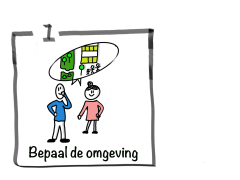
With any plan, it is important to consider for yourself: who is going to be affected by this and who do I need to make it happen? Are you building a new garage? If so, it may affect your adjacent neighbors. Think of noise during construction or shade in their yard. In other cases, such as if you want to expand your business, more people are going to notice your plan, such as nearby businesses or users of an area. Health then that all owners and/or users in the area can participate in the conversation. The greater the impact of your plan, the larger the circle of direct stakeholders. There may also be stakeholders who are indirectly involved, such as residents' associations, business owners, an environmental group or a community organization.
Think about what stakeholders can think about
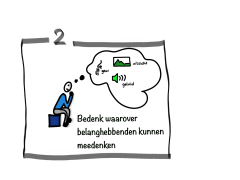
Before the conversation takes place, it is good to determine what role participants have. If you are going to replace a driveway, letting your neighbors know about it alone may be sufficient. If you want to organize a neighborhood party, then it is useful to let your neighbors help decide where, when and how. So participation can take different forms:
- Letting people know you have a plan;
- Getting people to think about your plan;
- Getting people to participate in your plan;
- Getting people to have a say in your plan.
By outlining in advance the role of stakeholders and the space in your plan for them to think or work with you, you create clarity for both yourself and others.
Invite stakeholders
As the initiator, you are responsible for organizing the environmental dialogue. Depending on the impact your plan will have on the surrounding area, invite stakeholders at least two weeks before the discussion takes place. Be the first to inform direct neighbors and Health that they get first-hand information from you as the initiator. Next, engage with all stakeholders. Several rounds of consultation may be necessary, depending on the scope and impact of your plan.
Have the conversation, make it easy and clear
Ideally, consult with stakeholders at the site where the plan will soon be located. Also work with images. It is easier to participate if you know what it looks like and where it will be located. Use the images to explain your ideas. Also indicate what you have already taken into account when it comes to your surroundings. The participants then get a chance to respond to this. During the discussion, try to bring up interests, objections, concerns or ideas. Find out what those involved think is important. Indicate whether or not you can do something with the comments and why. Often the budget is already fixed, decisions have already been made, or there are simply regulations that must be taken into account. Next, ask the participants whether or not they are satisfied with your response. Also make good agreements about the follow-up. Keep communicating during the process. Do so openly, honestly and transparently. Not only prior to the permit application, but also during the implementation of your plan.
Make a record of each conversation
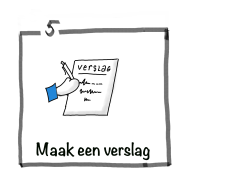
It is important for an initiator to make a report. In it, include at least:
- Where and when the conversation took place;
- Who you invited to do that;
- Who was present as the owner/user of which property;
- who have opted out;
- A summary of what you as initiator said, what was brought in by the participants and what the final outcome of the discussion was. In doing so, give an assessment of whether there was strong support, limited support or no support for your plan;
- agreements you have made.
Send the report to interview participants
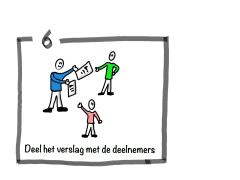
If you want to adjust your plan as a result of the conversation, clearly state what the changes are from the original plan. If you choose not to adjust the plan, describe why you chose to do so. Send the report to all participants.
Submit your permit application with the interview report
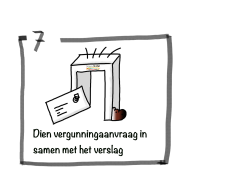
Once the conversation with stakeholders is well concluded, it is time to submit an application for an environmental permit. Attach to your application the conversation reports and a summary of them. Along with other information, the municipality needs this report to come to an informed decision.
How does the municipality assess the environmental dialogue?
When you apply for an environmental permit, the municipality also weighs participation, taking into account the scope of your initiative. The municipality looks at who you involved, how you involved them and what you did with the results of the conversation.
The municipality will make a decision on your application, weighing a variety of issues in addition to participation. If you have had the conversation and you can show that to the municipality, that can help you get a permit. Good participation helps but does not guarantee getting a permit. Also, the official public participation procedures and the possibility for objection and appeal simply remain. But, as indicated earlier, by having a good conversation with your surroundings, you can make your plan better and there is more chance of support.
Need advice?
Especially with large initiatives, it is wise to contact the municipality at an early stage. The contact person linked to your application can answer all your questions about participation and involving the neighborhood. But the municipality can also help you with smaller initiatives, in which case filling out the form "neighborhood dialogue" is often more than enough.
At the end of the day, it's all about keeping a good dialogue between initiators, stakeholders and municipality and explaining to each other why certain choices are being made. In this way, we can continue to work together and look together for the best solution for the communities in Leudal.
Would you like more information? Then contact the Space Department at (0475) 85 90 00.