
Mantel care home
What is it
A informal care home is a specially designed home located on the same property as the home of a person in need of care or immediate family. The purpose of a informal care home is to facilitate and support informal care. Informal care homes are often designed to maintain independence, but at the same time be close enough for the informal caregiver to provide needed Health and Health .
These homes can vary in size and design, but they come with all the basic amenities such as a kitchen, bathroom, bedroom, and living space. They can be built as a stand-alone unit, an addition to an existing home, or even as a converted space within an existing house.
Mantel care homes can be a practical solution for families who want to share Health for a family member while still maintaining some degree of privacy and independence. They can also help reduce pressure on formal care services and promote a better quality of life for both the care recipient and the family caregiver.
Permit-free under Requirements
A care home may be built permit-free when the spatial building regulations of the environmental plan are met, for example:
- The dwelling is located in the rear yard and if there is sufficient space (maximum percentage of the rear yard, to be consulted in the environmental plan)
- Converting an existing outbuilding into a family care home
- In the countryside there are additional possibilities if the backyard is already fully built up. You may then only place a unit for informal care living that can be moved and removed again afterwards. The unit may be up to 100 m2, in addition to the maximum allowable construction.
You must comply with the BBL (Building Works Environment Decree), which contains the technical building regulations. These rules focus on safety, health, durability and usability.
If the above requirements are not met, it is necessary to apply for a permit from the municipality.
What to do
- Check online to see if your building plans are permit-free. If you still need to apply for a permit, you can also do so through this counter.
Frequently Asked Questions
As an extra service, we offer answers to common questions via this website. If your question is not listed or if you prefer to contact us in person, please contact one of our staff members of the Development Team, Space Department (by phone at (0475) 85 90 00 or in writing at BBPOmgeving@leudal.nl.
1. When does informal care exist?
For an informal care home, there must be informal care. There is informal care when intensive, unpaid and often long-term Health is structurally provided to loved ones, for example a partner, parent or child. More information can be found on our website on the page Mantelzorg and on the website of MantelzorgNL and the Rijksoverheid.
There is no such thing as official proof that you are a caregiver. More information can be found on the website of the Ministry of Health, Welfare and Sport.
2. Who is allowed to live in a family care home?
The informal care home may be occupied by a maximum of one household. This household may consist of a maximum of two persons, at least one of whom receives or provides informal care. Informal caregivers do not have to have a family relationship; informal caregivers must have a personal relationship with the person they are caring for. This can be a partner, parent, child, neighbor, friend or acquaintance.
3. What does relocatable mean?
After use, the home must be moveable again in its entirety on a trailer to another location.
4. What is the backyard area?
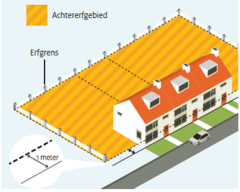
The rear yard area is the area 1 meter behind the front facade. For a corner house where the yard abuts a publicly accessible area, the rear yard area runs parallel to the public area from the side elevation of the house.
See also the image below.
5. Must the informal care home be within the building envelope?
The care home may be placed on the backyard area without a permit (provided the maximum percentage for building is not exceeded). The care home must be located on the area where the destination is 'residential', it is not possible to place a care home on an area where the destination is 'agricultural'.
6. Are there any other opportunities for housing?
The Housing Acceleration Agenda offers various opportunities for housing construction. With the private (re)construction component, we respond to individual housingHealth) solutions. This provides opportunities for splitting up (too) large houses, splitting off gardens and filling in individual plots (in residential areas). This is subject to Requirements. Read more about the Housing Acceleration Agenda on the Housing Policy page.
Disclaimer
For the sake of completeness, please note that these questions and answers are an additional service from the municipality to you. You cannot derive any rights from the answers on this website.