
Climate buffer Neeritter
Dutch surface water does not yet meet the standards of the European Water Framework Directive (WFD). To improve this, the water boards and municipalities are taking measures and working to improve water quality. This also applies to the Neeritter sewerage area.

What is the Water Framework Directive?
The WFD is a European directive on the quality of surface water and groundwater. In 2000, European Union (EU) countries adopted this directive. All water in the Netherlands must be a good habitat for the plants and animals that belong there by 2027. And it must be reasonably easy to make drinking water from it. The WFD has also been incorporated into the Dutch Water Act.
What are we going to do?
The sewer system of Neeritter is equipped with one mixed overflow on the east side of the village center. This overflow is located in the Vijverbroekstraat and discharges into the Itterbeek. This overflow currently does not meet the standard applicable under the Water Framework Directive (WFD). Because the Itterbeek is classified as 'very vulnerable', a stricter standard applies to the amount of overflows. To comply with the WFD, additional storage capacity is needed or stormwater must be disconnected from the sewer system for a significant portion of the village core. One of the options for meeting the WFD is to realize additional storage capacity.
Normally, constructing an additional storage facility behind or near the external overflow is a logical choice. However, due to lack of space this is not feasible at Vijverbroekstraat. In order to achieve the WFD through additional storage, a location must be found elsewhere where space is available and where it is also feasible to drain the sewage. A suitable plot for realizing WFD storage is located on the northeast side of the village center. In order to 'feed' the storage facility, several adjustments to the sewer system are required to direct sewage water from the existing overflow on Vijverbroekstraat to the newly constructed storage facility. The measures in question will mainly take place in the area framed in red.
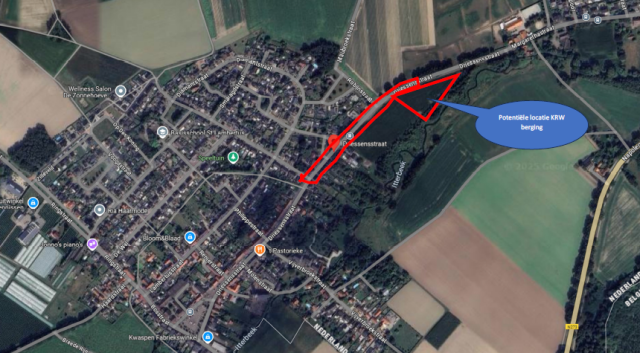
The plan area goes from approximately the junction Maartenstraat - Driessensstraat to just beyond the border of the village center of Neeritter. In the new situation the existing pavement will be reinstated as much as possible, i.e. asphalt pavement will remain asphalt pavement and elementary pavement will remain elementary pavement. With the exception of the intersection Driessensstraat - Robijnstraat, this will be redesigned. Furthermore, the existing sewer will be partially enlarged and an overflow line will be installed towards the newly constructed buffer.
Some minor adjustments to the sewer manholes at the intersection Lambertusstraat/Luciastraat and intersection Op den Heuvel/De wal are still being carried out. Furthermore, an adjustment to the overflow pit in Vijverbroekstraat towards Itterbeek will also be carried out.
What opportunities do we want to pursue further?
- Driessenstraat is one of the roads used school-home route towards the new school in Ittervoort. On Driessenstraat the current bicycle crossing was identified as a bottleneck in the Boundary 12 report. Moving the crossing further from the bus stop will make it much clearer. We are now including this in the plan.
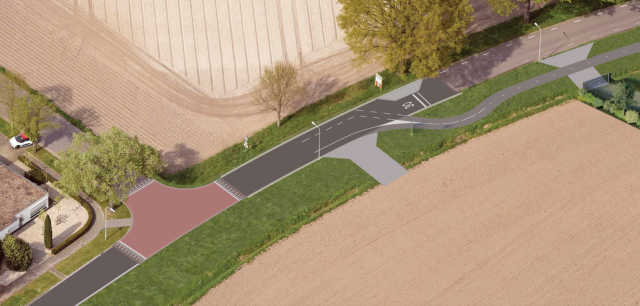
- The connection with Ruby Street, Safier Street and Martin Street will also be made more unambiguous and recognizable.

Information Evening
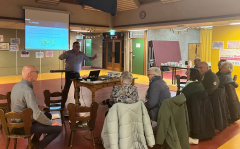
On Thursday, March 13, together with consulting firm Kragten, we organized an information evening for those living near the work area framed in red. On this evening the plan was not only presented, but there was also constructive discussion about the design of the Driessenstraat. After all, the residents are the people who walk, bike or drive their cars there every day and know what is happening and needed in their street. Many of the comments and suggestions made will be investigated in the coming period. Residents will be informed shortly about which suggestions will or will not be included in the design.
We look back on constructive residents' evening where we picked up some concerns and suggestions.
Global Planning
- Work preparation and tendering
- Until early August 2025
- Implementation
- Late September/early October 2025 to late July 2026 (2026 construction vacation)
- Work will start only once the work on Brigittastraat/Margarethastraat is completed.
- The Citizens' Initiative "greening Krekelbergplein" can start after completion of the project "Climate Buffer Neeritter"
Questions?
For questions, please contact the project managers Patrick Sanders by email at pa.sanders@leudal.nl or John Janssen by email at j.janssen@leudal.nl or by phone at (0475) 85 90 00.