
Letter of Intent for the Pilot Phase of the Limburg Agricultural Retention Initiative Signed
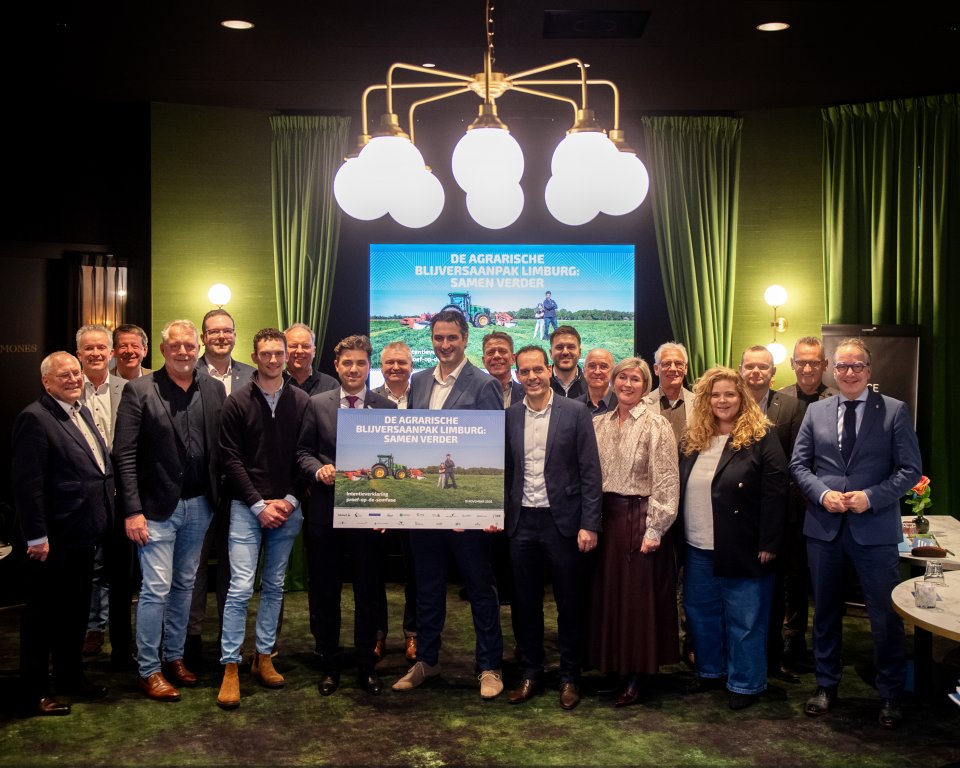
Roermond – Twenty organizations are working together to explore how they can help Limburg farmers and horticulturists whose future plans have stalled, so that they can maintain the hope of continuing their businesses. On Thursday, they signed a letter of intent for the pilot phase of the Limburg Agricultural Retention Initiative. The signing took place at Theater De Oranjerie in Roermond, on the day of the annual conference marking the Limburg Agricultural and Horticultural Association’s (LLTB) 130th anniversary.
The Limburg Agricultural Retention Initiative is intended for farmers and horticulturists from all sectors who have a forward-looking business plan that offers societal added value. Such plans sometimes run into roadblocks related to land, funding, or permits: available land, a suitable revenue model, financing, permits, and community support. For example, a permit application might be rejected because a plan fails to meet a single requirement, even though that one requirement does not outweigh the societal benefits
, says LLTB Chairman Thijs Rompelberg.
The “Blijvers” Approach is not a replacement for the nitrogen approach and does not provide any exceptions to existing rules
, says Provincial Executive Member Jasper Kuntzelaers. The entrepreneur has the idea and the plan. We bring together the expertise and resources of various parties to explore what is actually possible at that specific location. Not everything is possible, and we’re honest about that. But where there is room for action, we work together to make the most of it.
Instead of focusing on those who are leaving the industry, we need to encourage agricultural entrepreneurs to stay in business. That requires courage and cooperation. That is the approach of the “Agricultural Retention Initiative
,” says Merijn Luijkx, acting director of Food & Agri Limburg at Rabobank. Agricultural entrepreneurs contribute to food security, as well as to solutions for energy, nature, the climate, and our landscape.
It is necessary to evaluate well-founded plans with a fresh perspective and from a broader viewpoint
, says Frank Eijking, chairman of the Limburg Agricultural Youth Contact (LAJK). Existing regulations are too often based on outdated knowledge and insights. This approach can truly offer opportunities for entrepreneurs, the local community, and Limburg.
Twenty organizations are working together to explore possibilities
The Province of Limburg, the LLTB, the LAJK, and Rabobank had previously developed the approach together. In addition to these four parties, the letter of intent was signed by the municipalities of Weert, Nederweert, Venray, Horst aan de Maas, Peel en Maas, Leudal, Bergen, Roerdalen, and Beekdaelen; the Limburg Water Board; the Limburg Water Supply Company (WML); Staatsbosbeheer; Het Limburgs Landschap; Natuurrijk Limburg; the Limburg Nature and Environment Federation; and Natuurmonumenten.
Only time will tell what works
During the pilot phase, the approach will be tested using specific real-world cases in a number of municipalities in Limburg. The method has yet to prove itself in practice. The pilot is intended to show what works and where adjustments are needed. Whether and how the approach will subsequently be implemented on a broader scale depends on the results of the pilot. The letter of intent is valid through December 31, 2027.
By signing the agreement, twenty parties are reaffirming their shared commitment to helping farmers and horticulturists with sound business plans develop their operations in a way that is future-proof. Rompelberg and Kuntzelaers reflected on the signing during the annual conference.
The conference is dedicated to the LLTB’s 130th anniversary. Since 1896, the LLTB has been representing the interests of farmers and horticulturists in Limburg. For the LLTB, this anniversary is a time to look back and to look ahead.