
Oak processionary caterpillar, control

Information monitoring and control oak processionary caterpillar Leudal

The oak processionary caterpillar (Thaumetopoea processionea) is the caterpillar of a moth that is common in Belgium and has also become increasingly common in the Netherlands since 1990.

The microscopic fire hairs of the caterpillar pose a health hazard to humans. The hairs are 0.2 to 0.3 millimeters long. The hairs can then easily enter the skin, eyes and respiratory tract. The substances coming off the hairs cause an allergy-like rash, swelling, red eyes and itching. In most cases, the symptoms disappear on their own. Not everyone is equally sensitive to the fire hairs.

The adult butterflies lay eggs in the oak trees in August. These eggs overwinter in the oaks and around April/May the caterpillars hatch. After three molts, the burning hairs appear.
Monitoring

Our contractor is searching two to three designated locations for egg mixtures. This is started in March. The egg-layers found are marked. During the month of March, April and May, the eggs are monitored. Once the caterpillars have hatched, the leaf budding is awaited (temperature-dependent) and if it is sufficient, the signal is given for control. This is called the Go moment.

Preventive control

All municipalities apply preventive control. This has the advantage that the caterpillars are dead before they have the fire hairs. We always have to wait until there are enough leaves on the trees. The caterpillars need daily leaf green at this stage, so they are very vulnerable to the pesticide. Once the Go moment is issued we start treating the trees preventively. We do this 24 hours a day. In the outlying area, we mainly treat at night. We started this in 2022 and it has proven effective. It saves 1.5 weeks in control time. Control may cause temporary noise pollution. 

KWH sprayer deployment

The pesticide Xentari is blown into the trees with a mist sprayer, called a KWH sprayer. Due to the electrostatic action, the spray liquid carries a small negative charge and adheres to the positive leaf mass. This is the reason it does not "rain" under the treated trees.

The operation is easier to explain:

It can be compared to a balloon. If you rub a balloon against your clothes a few times, the balloon automatically "sticks" to the clothes. The balloon then also becomes static. Similarly, the drug sticks to the leaves of trees.

Xentari wg

The pesticide used is Xentari WG. It is a biological agent that is not harmful to humans or the environment. Also, the natural enemies of the caterpillar, such as ichneumon wasps and flies, bees and mites, are not affected by the pesticide. A separate article on the website explains the drug Xentari.

Legislation

The cooperating municipalities shall take the following data into account in combating:

  • butterfly foundation's Maps ;
  • the 2011 report legal framework.

Maps butterfly foundation

There are several protected butterfly species whose caterpillars live on and directly near oak trees during the same period when oak processionary caterpillars are present. Application of chemical or biological pesticides at sites where protected butterfly species occur is punishable under the Nature Protection Act. Sites where protected butterfly species occur are not sprayed. Here curative control takes place (sucking out or burning the nests).

The 2011 report legal framework

The report provides guidance to site managers and policy makers. The report contains cases for agencies, municipalities and individuals on the legal framework of the oak processionary caterpillar problem.

"Natural" measures

The measures below have been implemented as natural control of the oak processionary caterpillar:

  • In Leudal, 600 tit boxes were hung in 2020 because cabbage and blue tits are natural enemies of the caterpillar;
  • IKL placed another 50 nesting boxes of big-eared bats. These will soon eat out-flying oak processionary butterflies and thus prevent them from laying eggs;
  • Where traffic safety permits, we will not mow roadsides near oak lanes in the countryside and in forests in the spring. This will benefit all kinds of natural enemies of the caterpillar such as ichneumon flies and ichneumon wasps;

Control private trees

The municipality only performs preventive control on municipal trees.

If you wish to have trees in your yard or garden treated against the processionary caterpillar you will have to arrange for this yourself and at your own expense. This applies to oak trees in private gardens, institutions, schools, and all grounds and locations where the municipality does not own them.

Tip: always discuss a price in advance so there are no surprises.

For example, you can contact :

Hoveniersbedrijf Vaessen in Maasbree
Internet: www.hermanvaessen.nl
Phone: 077-4651708

Health complaints oak processionary caterpillar

For health information, contact the GGD Limburg-Noord (tel. 077-8504848). Or check the website: www.ggdlimburgnoord.nl.

Facts

  • Control takes place in cores and outdoor areas where many people live or congregate such as, residential centers, bike paths, through roads, sports facilities, playgrounds, etc;
  • generally, along unpaved roads and footpaths, control is not carried out because many private properties lie along these, in other words, the municipality has few or no forests here. Moreover, the effective period of control is very short so the municipality concentrates on the nuisance areas;
  • rainfall and high winds can have a negative effect on control. Rainfall washes the pesticide off the leaves. Strong winds prevent the pesticide from reaching the tops of large trees. This is because in the early stages, the caterpillars are at the top of the trees;
  • the action of Xentari is about 8 to 10 days. The processionary caterpillar is a nocturnal animal and eats leaves at night. Often after control, 1 night is enough to kill the caterpillar.
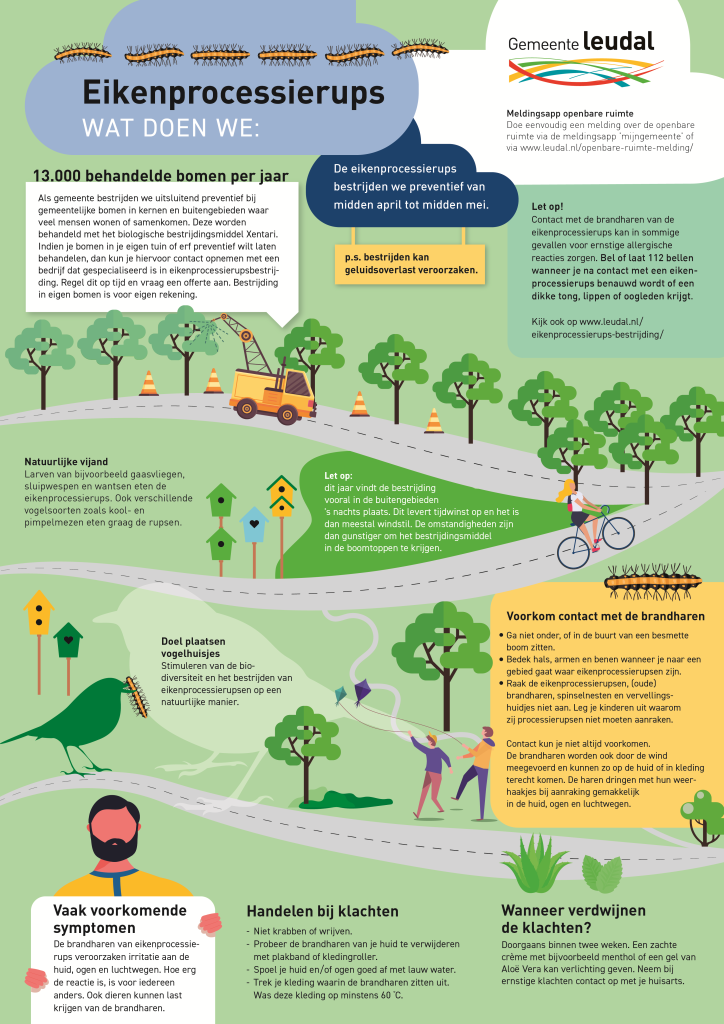
Transcribed text in drop-down field below image

If the image is not easy to read, you can also download it as a PDF document.

Written out text version Infographic

Public space notification app

Easily make a report about public space via the report app 'my municipality' or via www.leudal.nl/openbare-ruimte-melding/

Oak Processionary Moth - What we do

13,000 trees treated per year

As a municipality, we only control preventively on municipal trees in cores and outlying areas where many people live or congregate. These are treated with the biological pesticide Xentari. If you want to have trees in your own garden or yard treated preventively, you can contact a company that specializes in oak processionary caterpillar control. Arrange this on time and get a quote. Control in your own trees is at your own expense.

We control the oak processionary caterpillar preventively from mid-April to mid-May.
P.S. Control may cause noise pollution.

Note!

Contact with the oak processionary caterpillar's fire hairs can cause severe allergic reactions in some cases. Call or have 911 called if you become stuffy or develop a thick tongue, lips or eyelids after contact with an oak processionary caterpillar. Also visit https://www.leudal.nl/eikenprocessierups-bestrijding/.

Natural enemy

Larvae of, for example, lacewings, parasitic wasps and bugs eat the oak processionary caterpillar. Various bird species such as cabbage and blue tits also like to eat the caterpillars.

Note!

This year, control will take place mainly at night in the outlying areas. This saves time and it is usually windless then. Conditions are then more favorable for getting the pesticide into the treetops.

Target placement of birdhouses

Stimulate biodiversity and control oak processionary caterpillars naturally.

Avoid contact with the fire hairs

  • Do not sit under, or near, an infected tree.
  • Cover neck, arms and legs when going to an area where oak processionary caterpillars are present.
  • Do not touch oak processionary caterpillars, (old) fire hairs, spider nests and shedding skins. Explain to your children why they should not touch processionary caterpillars.

Contact cannot always be prevented. The burning hairs are also carried by the wind and can end up on the skin or in clothing. The hairs with their barbs easily penetrate the skin, eyes and respiratory tract when touched.

Common symptoms

The burning hairs of oak processionary caterpillars cause irritation to the skin, eyes and respiratory tract. How bad the reaction is is different for everyone. Animals can also be affected by the fire hairs.

Acting on complaints

  • Do not scratch or rub.
  • Try removing the burning hairs from your skin with tape or clothing rollers.
  • Rinse your skin and/or eyes well with lukewarm water.
  • Take off your clothes containing the fire hairs. Wash these clothes at at least 60 °C.

When do the symptoms disappear?

Usually within two weeks. A gentle cream with menthol or a gel of Aloe Vera, for example, may provide relief. In case of severe symptoms, contact your doctor.
 

Nuisance

  • The deployment of the spray gun may cause some noise pollution;
  • due to the short period to effectively control the oak processionary caterpillar, normal working hours may be waived.

Collaborative

In 2007, on the initiative of Leudal municipality, an alliance of municipalities was established with the aim of jointly tackling the nuisance of the oak processionary caterpillar.

The participating municipalities are: Leudal, Peel & Maas, Roermond, Weert, Roerdalen, Beesel, Nederweert and Echt-Susteren. This partnership is completed by an expert company, Herman Vaessen BV of Maasbree.